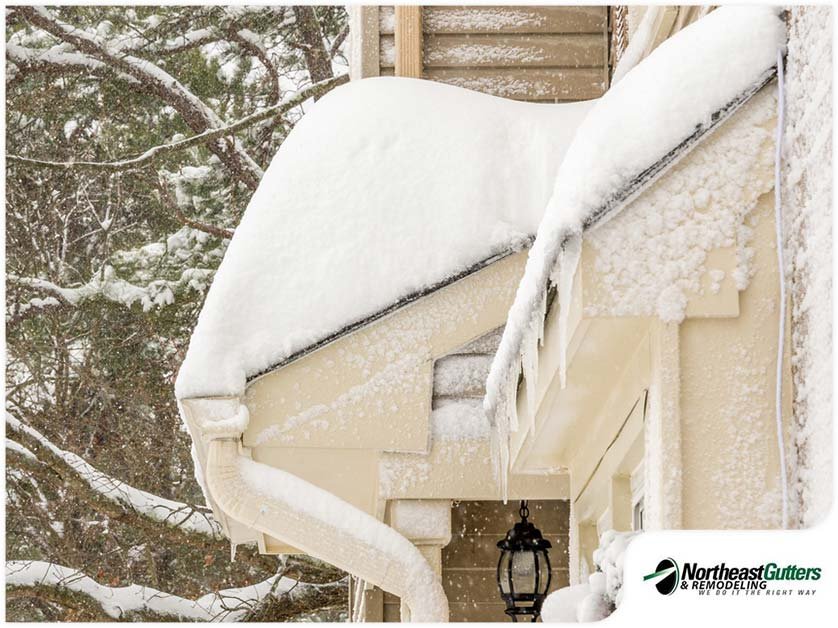
An ice dam is a ridge of ice at the roof edge that traps meltwater, and ignoring one lets water back up under the shingles and into attic insulation, ceilings and walls, as Michigan State University Extension explains. Most dams trace back to heat escaping from the living space into the attic, so the lasting fix starts inside the house.
Northeast Gutters & Remodeling hears from Avon, Connecticut homeowners every winter about ice ridges and long icicles at the roof edge. This guide covers how dams form, what they damage, what stops them for good and what to do while one is on your roof.
How Ice Dams Form
Heat from the house warms the attic and the roof, which melts the snow higher up. The meltwater runs down under the snow and refreezes at the eaves, the coldest part of the roof.
Dams and icicles are most common when snow covers the roof, heat escapes through it and outdoor temperatures sit just below freezing, according to NDSU Extension. As the ice grows, the water behind it can seep under the shingles.
The area above the exterior walls is a common weak point. UMass Amherst building scientist Paul Fisette notes that rafters usually sit directly on the walls, which leaves little room for insulation and gives warm air an easy path to the roof edge.
What Ice Dams Can Damage
- Ceilings and walls: water that backs up under the shingles can stain ceilings and soak walls.
- Insulation: wet attic insulation loses its value, and UMass notes that soaked insulation can stay compressed and thinner after it dries.
- Mold and structure: NDSU Extension lists ceiling stains, structural damage and mold growth among the results.
- Paint: moisture inside wall cavities can show up later as blistering or peeling paint, long after the ice is gone.
- Gutters: heavy ice can bend gutters and pull hangers away from the fascia.
- People and property: large icicles and sliding ice can hurt someone or damage railings and landscaping.
What Actually Prevents Ice Dams
Michigan State University Extension names the root problem as unwanted attic heat, usually from too little insulation or too little ventilation. Air leaks matter just as much, because insulation slows heat but does not stop warm air from rising through small gaps.
The table shows the measures these sources recommend. Each one goes after the cause instead of the symptom.
| Measure | What it does | Source |
|---|---|---|
| Air seal the attic | Closes gaps around plumbing, wiring, recessed lights, chimneys and the attic hatch so warm air stops rising | NDSU Extension, UMass |
| Add attic insulation | Slows heat loss through the ceiling; the target depends on your climate zone | ENERGY STAR |
| Keep insulation off the soffit | Baffles hold insulation back so cold air can still enter through the soffit vents | NDSU Extension |
| Ventilate soffit to ridge | Continuous inlets and outlets wash the underside of the roof deck with cold air | UMass |
| Rake the lower roof | Clears snow at the edge so less meltwater reaches the eaves | NDSU Extension |
| Ice and water shield | Adds a second line of defense under the shingles but does not fix the cause | UMass |
| Heat cables | Melt ice to help water drain but treat the symptom only | NDSU Extension |
Connecticut is in climate zone 5, according to the Insulation Institute’s summary of the state energy code. For that zone, ENERGY STAR lists R-60 for an uninsulated attic and R-49 for one that already has 3 to 4 inches of insulation.
Ask your contractor which target fits your home, because codes and guidance can change. Our attic vent installation work covers the ventilation side.
Ice and Water Shield: A Second Line of Defense
Self-adhering membrane under the shingles along the eaves protects the roof if water does get past a dam. UMass calls it a reasonable backup for existing homes but not a cure, because it does nothing to stop heat from melting the snow.
The building code also calls for an ice barrier where ice has a history of forming along the eaves. The Meriden Building Division summarizes the rule: the membrane runs from the lowest roof edge to at least 24 inches inside the exterior wall line.
Rules can change, so confirm the current requirement with your town’s Building Department. If your roof is due for replacement, our roofing permits guide explains the permit side of the project.
What to Do When a Dam Has Already Formed
Both Extension sources suggest raking snow off the lower roof from the ground, because climbing a snowy roof is dangerous. NDSU adds that you should keep the rake away from overhead power lines.
Skip the hammer, shovel and ice pick. Fisette warns that chipping at roof ice often does more harm to people and roofs than the ice itself.
These steps are temporary and may not stop dams higher on the roof if the attic stays warm. When water is already getting inside, our steamed ice removal service uses low-pressure steam to open a drainage path instead of mechanical tools.
Our ice dam removal and rooftop snow removal services cover the rest of the winter work. The cause still needs fixing afterward.
If Water Is Already Inside
The Connecticut Insurance Department advises homeowners to contact their insurer as soon as possible, photograph the damage and make only the repairs needed to prevent further harm until the insurer inspects.
Coverage depends on your policy. Our guide on whether homeowners insurance covers damaged gutters covers the gutter side of a claim.
What Fixing the Cause Costs
The price depends on the attic size, how much insulation is already there, how easy the attic is to reach and whether ventilation needs to be added. A free on-site look is the only way to price your house, so we do not quote ranges in an article.
Connecticut’s Home Energy Solutions program starts with an assessment that includes sealing air leaks, followed by written recommendations for insulation. Ask about current incentives before you hire anyone, because program terms change.
When our team looks at an ice dam problem, we check the roof edge, the gutters, the attic ventilation openings and any wet insulation or ceiling stains. We also look for gutters that ice has bent or pulled away from the fascia.
You can see how we handle the gutter side on our residential gutter systems page and our Avon gutter installation page.
Questions Avon Homeowners Ask
What causes ice dams?
Heat escaping into the attic melts snow on the roof, and the water refreezes at the cold eaves. Too little insulation or ventilation is the usual root cause.
Are icicles a warning sign?
Dams and icicles show up under the same conditions: snow cover, heat escaping through the roof and temperatures just below freezing. Check the attic if you see them.
Do heat cables fix ice dams?
They can melt ice to help water drain, but NDSU Extension says they treat the symptom rather than prevent the problem. Fixing insulation and ventilation addresses the cause.
Can I remove an ice dam myself?
You can rake snow off the lower roof from the ground, keeping the rake away from power lines. Do not chip at the ice, and call a professional if water is already coming inside.
How much attic insulation do I need?
ENERGY STAR lists R-49 for an attic that already has 3 to 4 inches of insulation and R-60 for an uninsulated one in Connecticut’s climate zone. Ask your contractor to confirm the target for your home.
Do ice dams damage gutters?
Heavy ice can bend gutters and pull hangers away from the fascia. Have the gutters checked after a dam clears.
Does ice and water shield stop ice dams?
No. It adds a second layer under the shingles that can limit leaks, but heat loss from the attic is what creates the dam.
Does homeowners insurance cover ice dam damage?
That depends on your policy, so call your insurer or agent. The Connecticut Insurance Department advises taking photos and holding off on permanent repairs until the insurer inspects.
Get Your Roof Edge Checked Before the Next Snow
Call 860-899-7878 or request a free estimate, and we will look at your roof edge, gutters and attic airflow with you.
About the Author
Thiago Barboza Batista is the owner of Northeast Gutters & Remodeling, a family-owned contractor in Bloomfield, Connecticut, founded as a gutter company in 2004. He oversees seamless gutter, copper gutter, roofing and siding projects for homeowners across Connecticut, from the free on-site estimate to the final inspection.
Sources
- Michigan State University Extension, Tips to Prevent Ice Dams: how dams form, unwanted attic heat, soffit vents and temporary snow removal.
- NDSU Extension, Reduce Ice Dam and Icicle Damage: conditions for dams, air sealing, ventilation, roof rake safety and heat tape.
- UMass Amherst Building and Construction Technology, Preventing Ice Dams: eave heat loss, wet insulation, ice barrier membrane and chipping risks.
- ENERGY STAR, Recommended Home Insulation R-Values: attic targets by climate zone.
- Insulation Institute, Connecticut energy code summary: climate zone 5.
- Meriden Building Division, Asphalt Shingle Installation: ice barrier extent under the code.
- Connecticut Insurance Department, Consumer Alert, January 23, 2026: ice dams, claims and temporary repairs.
- Energize Connecticut, Home Energy Solutions: assessment, air sealing and insulation recommendations.