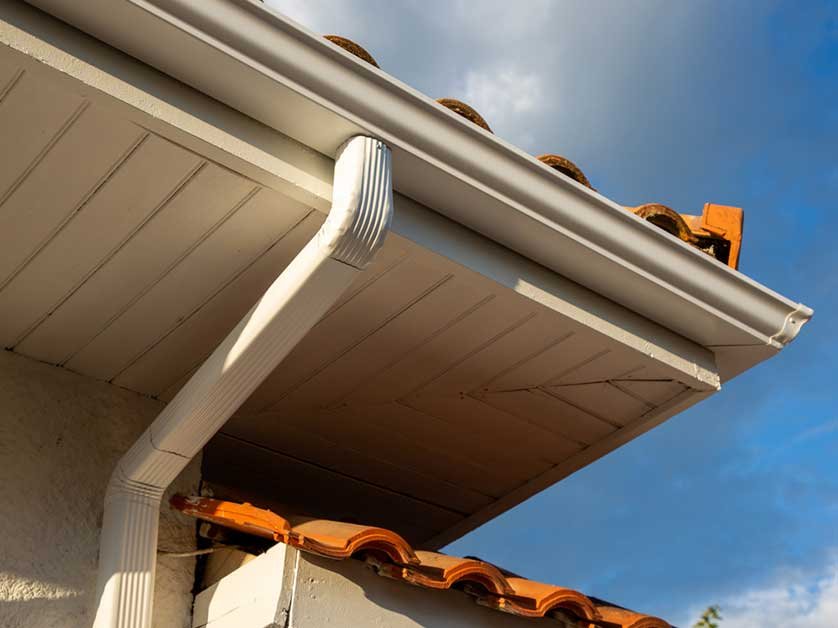
Residential gutters come in 4, 5 and 6 inch channels, and a wider channel only helps when the downspouts can empty it. Downspout size and spacing decide whether the system keeps up in a heavy storm.
Northeast Gutters & Remodeling sizes gutter systems for Connecticut homeowners from our Bloomfield base, using roof area and local rainfall, and this guide focuses on matching the channel to the downspouts.
Start With the Roof Plane
Each run collects water from the roof plane above it, so measure those planes rather than the footprint of the house. A long, steep roof pushes far more water into one run than a small, low roof does.
Standard Gutter Sizes
Researchers at the Pacific Northwest National Laboratory describe residential gutters as sold in 4, 5, and 6 inch channels. A wider channel moves water faster, but only when enough downspouts empty it.
Lowe’s gutter buying guide compares K-style and half-round profiles and lists the same three widths. Roof size and rainfall decide which width fits.
The Downspout Rule of Thumb
PNNL’s rule of thumb is about 1 square inch of downspout opening per 100 square feet of roof. For a section of 1,800 square feet, that works out to 18 square inches.
| Downspout size | Cross-section | Downspouts for 1,800 sq ft |
|---|---|---|
| 2 by 3 inches | 6 square inches | 3 |
| 3 by 4 inches | 12 square inches | 2 |
| 4 by 4 inches | 16 square inches | 2 |
Downspouts can be set 20 to 50 feet apart, and PNNL notes that tighter spacing copes better with peak storms. In heavy-rain areas it recommends adding gutter and downspout capacity. For the full sizing method, see our gutter sizing guide.
Slope and Discharge
PNNL calls for a slope of at least 1/16 inch per foot. The discharge pipe should carry water a minimum of 5 feet from the building and release it onto ground that falls away from the house.
When to Size Up
- Large roof planes that feed one short run.
- Steep pitches that move water quickly.
- Valleys that concentrate flow.
- Overflow history during heavy storms.
- Tall trees that add debris.
Our residential gutter systems and 5 K style seamless gutters crews size runs for each roof, and the aluminum seamless gutter installation team forms them on site. For existing problems, see our gutter repairs work and the post on gutter damage causes.
How We Size a Quote
At the house, our crew measures the roof planes that feed each run and notes the pitch, valleys, and downspout locations. We write the gutter width and downspout count into a scope, so the numbers are clear.
Gutter Size Questions From Connecticut Homeowners
What gutter sizes are available?
PNNL says gutters are sold in 4, 5, and 6 inch channels, and Lowe’s lists the same three widths. A wider channel carries more water faster, but only if enough downspouts drain it, so plan both parts together.
How many downspouts does my roof need?
PNNL’s rule of thumb is about 1 square inch of downspout opening per 100 square feet of roof. A section of 1,800 square feet needs 18 square inches, which is three downspouts of 2 by 3 inches.
How far apart should downspouts be?
PNNL says downspouts can sit 20 to 50 feet apart, and tighter spacing handles peak storms better. A long run with a single outlet is a common reason gutters overflow during a heavy downpour in spring.
What slope should a gutter have?
PNNL calls for a slope of at least 1/16 inch per foot toward the downspout. Too little pitch lets water pool in the trough, while a steady slope keeps water moving toward the outlet and away.
Is the biggest gutter the best choice?
A larger channel carries more water only if enough downspouts drain it, so downspout count and spacing matter as much as width. We size each run from the roof planes that feed it, not from habit.
Where should the water go after the downspout?
PNNL says the discharge pipe should carry water at least 5 feet from the building and empty onto grade that slopes away from the house. A buried drain should reach at least 10 feet from the wall.
Unsure What Size You Need?
Northeast Gutters & Remodeling can measure your roof and recommend a gutter and downspout plan.
Call 860-899-7878 or get a free estimate and we will book a visit.
About the Author
Thiago Barboza Batista is the owner of Northeast Gutters & Remodeling, a family-owned contractor in Bloomfield, Connecticut, founded as a gutter company in 2004. He oversees seamless gutter, copper gutter, roofing and siding projects for homeowners across Connecticut, from the free on-site estimate to the final inspection.
Sources
- PNNL: Gutters and Downspouts: Sizes, downspout rule, spacing, slope, and discharge.
- Lowe’s: Gutter Buying Guide: Profiles and widths.